Revolution: A New Power, A New Persecution
The Bolshevik revolution initially seemed like a promise: abolition of the Pale of Settlement, a decree on the equality of peoples. But it quickly became clear that tsarist antisemitism had been replaced by Soviet antisemitism — dressed in ideological clothes.
- 1918 — Nationalisation of businesses ruined Jewish traders and craftsmen
- 1919 — Hebrew banned as "the language of bourgeois nationalists"
- 1921 — Closures of cheders (Jewish elementary schools) across the country
- 1922–1930 — Systematic closure of synagogues; Chabad institutions targeted first
The Communists offered Jewish workers something: a secular Jewish culture in Yiddish, a role in the new order. But observant, traditional Jews — above all Chabad — got something else: active persecution by a Jewish section of the Communist Party itself.
The Yevsektsiya: Jewish Communists Persecuting Jewish Communities
The Yevsektsiya (Jewish Sections of the Communist Party, 1918–1930) was one of the most painful episodes in the history of Soviet Jewry. Jewish communists were tasked with destroying traditional Jewish life from within.
The Yevsektsiya organised show trials in which synagogues were "condemned" by the local Jewish community itself. Buildings were confiscated and turned into clubs, warehouses, or Party offices.
Lists of religious leaders were compiled. Rabbis, teachers, and community organisers were arrested on charges of "anti-Soviet activity," "counterrevolution," and "bourgeois nationalism."
Teaching Torah, Talmud, or Hebrew to children was made a criminal offence. Underground cheders and yeshivot became the only option for religious education.
Chabad was a particular target: its organisational strength, underground networks, and ideological resistance to communism made it the main enemy in the eyes of the Yevsektsiya.
The Yevsektsiya was dissolved in 1930 — by then, it had done most of its destructive work. Its leaders were themselves executed in the Stalinist purges of the 1930s.
The Arrest of the Frierdiker Rebbe: Death Sentence and Exile from the USSR
Seven Years Underground: What the Rebbe Built Before His Arrest
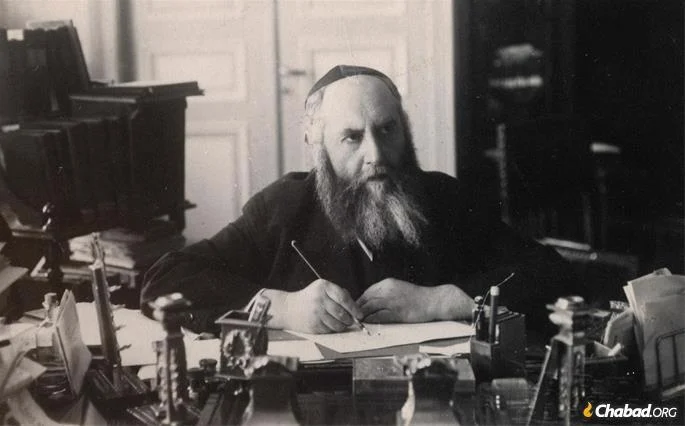
Rabbi Yosef Yitzchak Schneerson became the Sixth Lubavitcher Rebbe in 1920 — as Soviet power was already systematically dismantling Jewish religious life.
- Secret yeshivot — students rotated between cities to evade GPU surveillance
- Underground mikvehs — built in the basements of private homes
- Network of melamdim — secretly teaching Jewish children in apartments across the country
- Kosher shechita — covert ritual slaughter operated under total official prohibition
- Courier system — transporting funds, textbooks, and ritual objects across the USSR
The OGPU had been monitoring the entire network for years. The arrest was only a matter of time.
The Arrest: Agents with Drawn Pistols
That day Rabbi Yosef Yitzchak was receiving petitioners at his home — a routine audience with the Rebbe.
Without warning, OGPU agents burst into the room. One levelled a pistol directly at the Rebbe, expecting to see fear and immediate submission.
The Rebbe looked up at him — calm, unflinching — and spoke words that became one of the most quoted phrases in all of Chabad history.
"That toy can only frighten one who has many gods and values but a single world. I have one God and I know of two worlds — I have nothing to fear from your toy."— Rabbi Yosef Yitzchak Schneerson — to the OGPU agent with a pistol. 15 June 1927
The agent, according to accounts, lowered his weapon. The Rebbe took his Tehillim (book of Psalms) and followed the agents without a single word of complaint.
Spalernaya Prison: Interrogations Without Compromise
The Rebbe was taken to Spalernaya Prison — one of the most feared OGPU facilities in Leningrad.
The Rebbe refused to name a single person. Not one. Despite psychological pressure, threats, and night-time interrogations.
When the interrogator told him his activities were illegal, the Rebbe replied: "If the law prohibits what the Torah commands — the Torah is above the law."
When offered "registered" activity under Soviet supervision in exchange for freedom, he refused — knowing it would destroy the independence of the underground.
In prison he continued to pray three times a day and studied Torah from memory. The guards watched him with undisguised astonishment.
The Death Sentence: Received Without Fear
The OGPU tribunal pronounced its verdict: death by firing squad.
When told of the sentence, the Rebbe asked for paper and pen to record Chasidic teachings — thoughts that had come to him in prison. Then he took his Tehillim and continued to recite psalms.
"Let the body die — the teaching is immortal. Let them kill me — Chabad will survive. The Torah survived Pharaoh. It will survive this too."— From the Frierdiker Rebbe's writings at the time of the death sentence, June 1927
The International Campaign: The World Spoke Up for the Rebbe
The German government — through its embassy in Moscow — filed an official diplomatic protest. The Soviet Union valued the Rapallo Treaty and could not ignore it.
American Jewish organisations — including the Joint Distribution Committee — ran an active lobbying campaign through diplomatic channels.
Jews in Britain, France, and Poland bombarded their governments with petitions. Mass prayer gatherings were held in communities around the world.
The Rebbe's story reached the front pages of major newspapers. The Soviet Union, dependent on foreign credit, was acutely sensitive to its international image.
Three Steps: How a Death Sentence Became Freedom
(12–13 July 1927) Third commutation — freedom. Exile replaced with immediate expulsion from the USSR. 12–13 Tammuz became the second great holiday of Chabad.
12–13 Tammuz: Chabad's Second New Year
- Known as "HaGeulah" — The Redemption
- 12 Tammuz — the day the death sentence and exile were annulled
- 13 Tammuz — the day the Rebbe physically left prison
- Observed annually with farbrengens and study of the Frierdiker Rebbe's teachings on faith and steadfastness
The Road to Exile: Riga, Warsaw, and the Fight from Abroad
On leaving prison, the Rebbe crossed the border and arrived in Riga (Latvia, then an independent state). He later moved to Warsaw, where he rebuilt the Tomchei Temimim yeshiva and renewed Chabad activity across Poland.
From Warsaw he led the illegal network inside the USSR through couriers and coded correspondence. In 1940, when the Nazis occupied Poland, American Jews organised his rescue and he arrived in New York, from where he led Chabad until his death in 1950.
"They can take the body — but they will not take the soul. They can close a synagogue — but the Torah that a Jew carries within cannot be shut down by any decree."— Rabbi Yosef Yitzchak Schneerson, from a letter to Chasidim after expulsion from the USSR, 1927
Soviet power had hoped that expelling the Rebbe would decapitate the Chabad underground. Instead, Chabad went deeper underground, its network continued to function, and the Rebbe himself supported it from abroad for another twenty years.